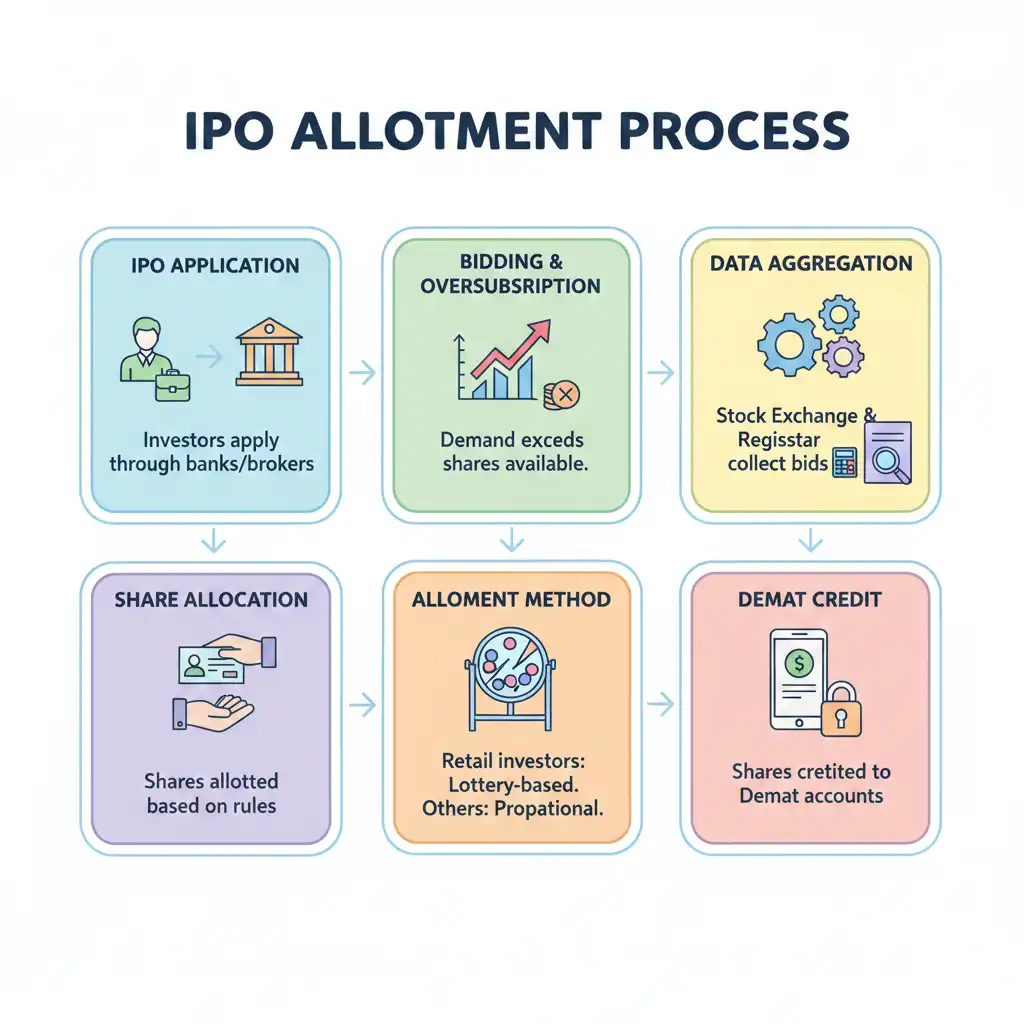
When a company launches an Initial Public Offering (IPO), thousands or even lakhs of investors apply for its shares. However, the number of shares offered is limited. This is where the IPO allotment process comes in. It decides who gets shares, how many shares they get, and who doesn’t.
This article explains how IPO allotment works in a clear way, using simple language and real-life logic.
What Is IPO Allotment?
IPO allotment is the process by which shares of an IPO are distributed to investors after the IPO application period ends.
Not every applicant is guaranteed shares. Allotment depends on:
- Number of shares offered
- Number of applications received
- Investor category
- Oversubscription level
Who Conducts the IPO Allotment?
The IPO allotment is handled by the registrar to the issue, not the company itself.
The registrar:
- Collects all valid applications
- Removes invalid or duplicate bids
- Finalizes allotment using prescribed rules
- Credits shares to demat accounts
The process is fully computerized and regulated, leaving no scope for manual manipulation.
Investor Categories in IPO
IPO shares are divided among three main categories:
1. Retail Individual Investors (RII)
- Application value up to ₹2 lakh
- Reserved portion: minimum 35%
2. Qualified Institutional Buyers (QIB)
- Mutual funds, banks, insurance companies
- Reserved portion: up to 50%
3. Non-Institutional Investors (NII / HNI)
- Application value above ₹2 lakh
- Reserved portion: minimum 15%
Each category has a separate allotment process.
Step-by-Step IPO Allotment Process
Step 1: IPO Subscription Closes
After the IPO closing date, total applications are counted category-wise.
Step 2: Checking Subscription Status
- If applications ≤ shares available → Full allotment
- If applications > shares available → Oversubscription
Most popular IPOs are oversubscribed, especially in the retail category.
Step 3: Retail Allotment Logic (Most Important)
Case 1: Retail Portion Not Oversubscribed
Every valid retail applicant receives full allotment.
Case 2: Retail Portion Oversubscribed
This is the most common situation.
In this case:
- Minimum one lot is allotted
- Allotment is done using a computerized lottery system
- Each valid applicant has an equal chance
👉 No preference is given based on:
- Early application
- Bank balance
- Broker
- PAN history
Example (Retail Oversubscription)
- Retail shares available: 1,00,000 shares
- Lot size: 50 shares
- Maximum possible allottees: 2,000
- Total valid applications: 6,000
Result:
- Only 2,000 investors will get 1 lot each
- Remaining 4,000 investors get no shares
- Selection is done randomly by computer
HNI / NII Allotment Process
- Allotment is proportionate, not lottery-based
- Bigger application = higher chance
- If oversubscribed heavily, minimum allotment rules apply
HNI allotment is more predictable compared to retail.
QIB Allotment Process
- Entirely proportionate basis
- No lottery system
- Large institutions apply with massive quantities
- Allotment follows SEBI-defined formulas
What Happens After Allotment?
1. Shares Credited to Demat Account
- Successful applicants receive shares
2. Refund of Blocked Amount
- For non-allottees, blocked money is unblocked automatically
- ASBA ensures money never leaves the bank unless shares are allotted
How to Check IPO Allotment Status
You can check allotment using:
- PAN number
- Application number
- Demat account details
Allotment status becomes available 1–3 days after IPO closing.
Common Myths About IPO Allotment
❌ Applying early increases chances
❌ Multiple demat accounts guarantee allotment
❌ Big bank balance helps in retail category
✅ Truth:
- All valid retail applications have equal probability
- Duplicate PAN applications are rejected
- Allotment is system-driven and transparent
Why Many Investors Don’t Get IPO Allotment
- High oversubscription
- Limited retail quota
- Huge investor participation
- Small lot size
Not getting allotment does not mean rejection—it’s simply probability.
Key Takeaways
- IPO allotment is rule-based and automated
- Retail allotment uses a lottery system
- ASBA ensures safety of investor funds
- Oversubscription reduces allotment probability
- No human interference is involved
Conclusion
Understanding how IPO allotment works helps investors set realistic expectations. The process is fair, transparent, and strictly regulated. While popular IPOs attract massive demand, allotment remains a matter of probability—especially for retail investors.
A disciplined approach, correct application details, and patience are the only things an investor can control.
FAQs
IPO allotment works by distributing shares to investors after the IPO closes. If the IPO is oversubscribed, retail investors receive shares through a computerized lottery system, while institutions get proportionate allotment.
For retail investors, IPO allotment is probability-based when an IPO is oversubscribed. Every valid retail application has an equal chance through a random computerized system.
No, applying early does not increase IPO allotment chances. All valid applications submitted before the IPO closing time are treated equally.
Most people do not get IPO allotment because popular IPOs receive far more applications than available shares, reducing individual allotment probability.
IPO allotment is usually finalized within 1 to 3 working days after the IPO subscription closes, followed by credit of shares to demat accounts.